

Brochures and Annual Reports
Through the lens of eight photographs, the brochure »30 Years of the Dubnow Institute« introduces the Dubnow Institute, a research institute based in Leipzig and named after the Russian Jewish historian.
Accompanying the exhibition »The Determining Gaze. Images of Jewish Life in Postwar Poland«, a brochure was published that provides an insight into the content of the exhibition and contains selected photographic material from the exhibition.
The brochure »Think Lab«, published in summer 2022, offers a glimpse at the research of the Dubnow Institute as if through the window of a laboratory: In about twenty short articles, it spotlights the processes of our academic work, its underlying our questions and methods.
In our annual reports, we document the activities of the preceding calendar year. Here you can find the most important events as well as an overview of the institute’s employees, their research projects and publications, and our partners. This public format, which we established in 2019, is one of the measures we have taken to conform to the structures of the Leibniz Association and replaces the internal reports that appeared hitherto. From 1999 to 2014, our activities were documented in our »Bulletin.«

Through the lens of eight photographs, this brochure introduces the Dubnow Institute. Named after the Russian Jewish historian, this research institute based in Leipzig was founded in 1995 following a decision by the Saxon state parliament.
The cover photo shows the 61-year-old Russian Jewish historian Simon Dubnow (1860, Mstislaw, Russian Empire – 1941, Riga) packing up his library before his departure for Berlin in April 1922. He did not see a future in Soviet Russia either for himself or for his cause – the recognition of the Jewish collective as a people and a diasporic nation. In Germany, he completed his magnum opus, the ten-volume World History of the Jewish People, while at the same time witnessing the rise of National Socialism. In 1933, he fled from the Nazis to Riga. Following the occupation of the Baltic region by the Germans, he was murdered there in December 1941 alongside the majority of the Jews of Latvia.
Like in a burning lens, this scene of his departure compresses the agenda of the Leibniz Institute for Jewish History and Culture, which is named after Simon Dubnow. His biography epitomizes the Jewish experiences of the nineteenth and twentieth centuries: emancipation and autonomy, multilingualism, mobility, and the transfer of knowledge, but also forced migration, fl ight, expulsion, and experiences of violence. Dubnow’s historiography, which is characterized by the embedding of the Jewish experience
in its surrounding contexts, shapes the research approach of the institute. His sphere of activity, namely Central and Eastern Europe, augmented by the lands of Jewish emigration – above all Israel and America – form the focus of its scholarly activities. At the same time, this photograph of a box of books points to another important research topic: objects that migrate, property that is left behind, and collections that are scattered and destroyed.

The exhibition and its brochure focus on photographs of Jewish life in Poland immediately after the Holocaust. Both were realized in close cooperation with the Jewish Historical Institute Emanuel Ringelblum in Warsaw, which preserves one of the most important collections on Polish-Jewish history. A unique collection of images, in particular photo albums, provides an insight into the ambivalence of the first postwar years.
Jewish life in Poland immediately after the Holocaust was full of ambivalences and contradictory experiences: between self-determination and violence, mourning and new beginnings, reconstruction and emigration. In Lower Silesia, on former German territory, Jewish life briefly flourished again for a few years. At the same time, there were repeated attacks against Jews throughout the country, the largest of which was the Kielce Pogrom in the summer of 1946. This escalation of violence was one of the main reasons for the emigration of a large number of Holocaust survivors by the end of the decade.
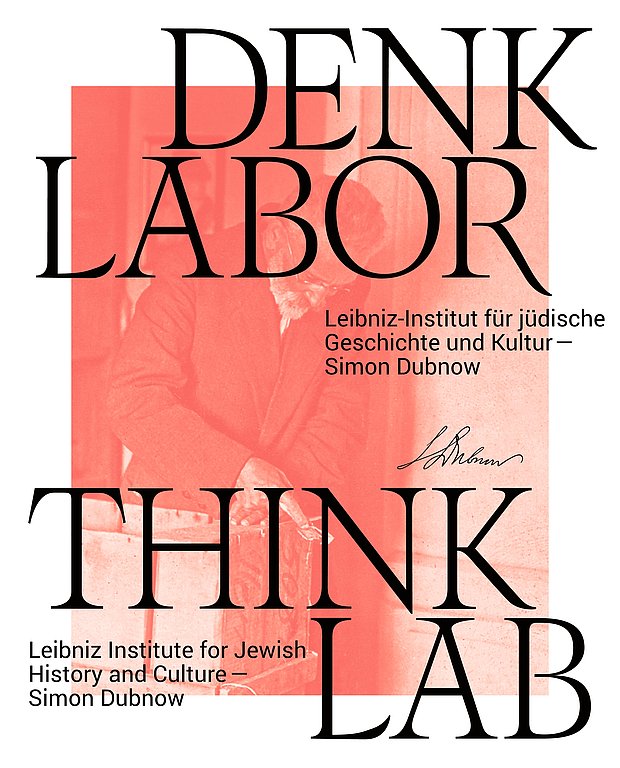
The broschure »Think Lab«, developed in the research project »Shifting Knowledge,« presents the research of the Dubnow Institute in about 20 articles. For this brochure, however, we have deliberately loosened our Institute’s structure. In the Institute’s everyday life, all of the topics, mentioned in the broschure, are anchored in one of our three research units, namely »Politics,« »Law,« and »Knowledge,« or in the division »Knowledge Transfer.« For the brochure, however, we have invited colleagues and guests from various sections to cooperate and write jointly. By developing current and forward-looking overarching methodologies and questions, this collaboration has uncovered new innovative perspectives which we are now pleased to present to you in a collection of short essays. Each one is a glance through the window in our research institution. We wish you an inspiring and thoughtprovoking read.

Just released: Annual Report 2024
The Dubnow Institute's Annual Report 2024 has just been released. The 110-page report focuses on the International Research Training Group »Belongings: Jewish Material Culture in Twentieth-Century Europe and Beyond«. Based on the idea that Jewish history can be reconstructed, narrated, and remembered in a substantial and innovative way through the analysis of its world of objects, the »Belongings« brings together German, Israeli, and other international researchers from various academic career stages in the coming years.
In addition, the report documents the institute's research, reports on events and courses held in the past calendar year, and lists all 2024 publications and blog articles by the institute. The report can be downloaded free of charge as a PDF file.

Just released: Annual Report 2023
The Dubnow Institute's informative Annual Report 2023 has just been released. On almost 130 pages, it documents the Institute's research, reports on events and teaching in the past calendar year and shows all of the Institute's publications published in 2023. Milestones included the approval for the establishment of “Belongings”, the first German-Israeli Research Training Group in the humanities, the extraordinarily successful evaluation of the Institute by the Senate of the Leibniz Association and the international conference “Looking at the Ghetto ...”, which commemorated the Warsaw Ghetto Uprising 80 years earlier in April 2023. The report can be downloaded free of charge as a PDF.
Just released: Annual Report 2022
For the fourth time in a row, the annual report of the Dubnow Institute is published in its new design. It describes the new research projects started at the Institute in 2022, reports on events and courses in the past calendar year and shows all the Institute's publications that were published in 2022. It can be downloaded as a PDF free of charge.
Just released: Annual Report 2021
The annual report for the year 2021 can be viewed and downloaded as a PDF here on the website. It documents the activities of the preceding calendar year. Here you can find the most important events as well as an overview of the institute’s employees, their research projects and publications, and our partners.
Just released: Annual Report 2020
The annual report for the year 2020 has been published and can be viewed and downloaded as a PDF here on the website. It reports on a research-intensive year that was an unusual one in two aspects: due to the Corona pandemic and its consequences on the Institute's daily work, but also due to the founding of the Institute 25 years ago.
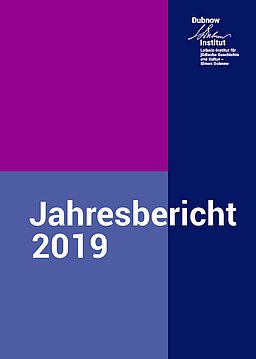
Just released: Annual Report 2019
The Annual Report 2019 of the Dubnow Institute has just been published. In previous years the Institute documented its activities in an internal activity report, and from 1999 to 2014 the Bulletin served as a reporting tool. The publication of the research projects, publications, events and courses from 2019 is one of many measures to fit into the structures of the Leibniz Association. The Annual Report is designed in the corporate design developed for the institute in 2019.
Further issues of the Bulletin
Further issues of the »Bulletins« can be found here:
Publication: Search